Loading content...
Loading content...
Loading content...
Loading content...
Loading content...

Loading content...
Loading content...
Loading content...
Loading content...
Loading content...
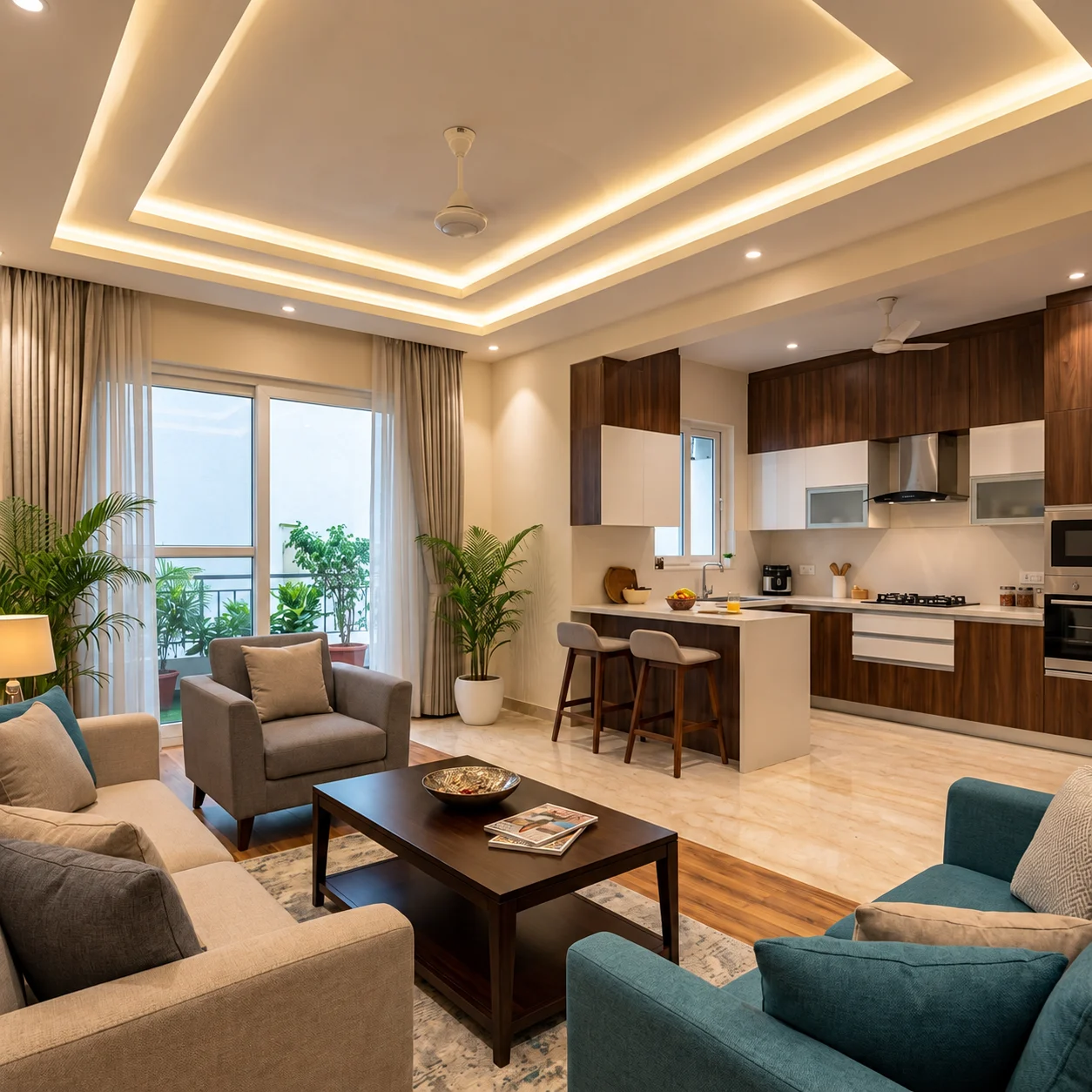
Once you have fixed a number in your head ₹30 lakh, ₹40 lakh, ₹50 lakh the harder question is where that money actually goes. An interior budget for a 4BHK villa isn’t one lump sum you hand over; it’s a split across ten-plus categories, and getting that split wrong is usually what causes homeowners to run out of money on the kitchen after over-spending on the living room. This piece walks through exactly how to divide a villa interior budget, with worked numbers, not just percentages that don’t add up.
Before allocating anything, separate two buckets that homeowners often blur together. Civil work structural changes, plastering, waterproofing, and any builder-provided base flooring is usually outside an interior budget unless you’ve explicitly asked your designer to quote for it. Interior work covers modular kitchens, wardrobes, false ceilings, painting, loose and custom furniture, lighting design, and soft finishes.
In a villa specifically, a few items sit in a grey zone staircase railings, additional electrical points for double-height areas, terrace decking and these should be explicitly listed as included or excluded in your quote before you sign anything. When in doubt, ask for it in writing.
Cost ranges mean little without scope attached to them. Here’s what each tier typically buys you, all figures excluding 18% GST unless your vendor states otherwise:
| Tier | Cost/sq. ft (before GST) | What’s Typically Included |
| Essential | ₹1,200–1,600 | Laminate-finish modular kitchen, false ceiling in living room and bedrooms only, standard wardrobe shutters, basic bathroom fittings |
| Mid-range | ₹1,600–2,400 | Better hardware brands, wardrobes extended to all bedrooms, false ceiling in foyer and bathrooms too, semi-custom loose furniture |
| Premium | ₹2,400–4,000+ | Full custom carpentry, branded modular kitchen, layered lighting design, custom furniture, premium flooring treatments, staircase cladding |
For a 2,800–3,500 sq. ft. 4BHK villa, this works out to roughly ₹20–35 lakh at the essential end and ₹42–60 lakh+ at the premium end, before GST. Add 18% GST on the service/labour component when comparing quotes a vendor quoting ₹40 lakh inclusive of GST and one quoting ₹40 lakh plus GST are not offering the same price.
The mistake most percentage-based budget guides make is listing category percentages that quietly add up to more than 100%, or ignoring contingency altogether until it’s needed and then borrowing it from somewhere else. Here’s the correct order:
| Category | % of Total Budget | Includes |
| Modular Kitchen | 22% | Carcass, shutters, countertop, hardware, chimney/hob |
| Wardrobes (all bedrooms) | 14% | Master + 3 other bedrooms, loft storage |
| Living & Dining | 14% | False ceiling, seating, lighting fixtures |
| Bedroom Furniture (non-wardrobe) | 8% | Beds, side tables, study units |
| Bathrooms (all) | 9% | Vanity, fittings, waterproofing touch-ups |
| Foyer & Pooja Room | 3% | Console, statement lighting, pooja unit |
| Utility Area | 3% | Storage, plumbing points, shelving |
| Staircase & Common Areas | 5% | Railing, under-stair storage, lighting |
| Terrace & Balcony | 2% | Railings, outdoor flooring, basic furniture |
| Painting, Electrical & Lighting | 5% | Full-home painting, wiring, fixtures |
| Contingency | 15% | Set aside first, spent only if needed |
| Total | 100% |
Applying the same percentages to three common budget levels:
| Category | ₹30L Budget | ₹40L Budget | ₹50L Budget |
| Modular Kitchen (22%) | ₹6.6L | ₹8.8L | ₹11L |
| Wardrobes (14%) | ₹4.2L | ₹5.6L | ₹7L |
| Living & Dining (14%) | ₹4.2L | ₹5.6L | ₹7L |
| Bedroom Furniture (8%) | ₹2.4L | ₹3.2L | ₹4L |
| Bathrooms (9%) | ₹2.7L | ₹3.6L | ₹4.5L |
| Foyer & Pooja (3%) | ₹0.9L | ₹1.2L | ₹1.5L |
| Utility (3%) | ₹0.9L | ₹1.2L | ₹1.5L |
| Staircase & Common (5%) | ₹1.5L | ₹2L | ₹2.5L |
| Terrace & Balcony (2%) | ₹0.6L | ₹0.8L | ₹1L |
| Painting/Electrical/Lighting (5%) | ₹1.5L | ₹2L | ₹2.5L |
| Contingency (15%) | ₹4.5L | ₹6L | ₹7.5L |
| Total | ₹30L | ₹40L | ₹50L |
A ₹30L budget sits close to the essential tier and usually means modular over custom carpentry almost everywhere. A ₹40L budget allows semi-custom kitchen and wardrobes with better hardware. A ₹50L budget starts opening up fully custom furniture and premium lighting design without stripping other categories.
It’s a common claim that villas always cost more per square foot than apartments, but that’s not strictly true it depends on scope. What genuinely adds cost in a villa is the presence of elements apartments don’t have:
If your villa doesn’t have most of these say, a compact single-storey layout your cost per square foot can land close to an apartment’s. The premium comes from what’s actually in the floor plan, not the word “villa” itself.
Sarjapur Road villas usually sit in established, IT-corridor-adjacent communities, so vendor access and labour availability are strong, keeping execution costs relatively predictable. If you’re deciding when to lock your design, our guide on finalizing interior design during ongoing civil work is worth reading before your MEP work begins here too.
Devanahalli villas, in our experience, tend to sit on larger, newer plots with more open shell space to fill which is directional, not a fixed rule, and spreads the same rupee budget thinner than a similarly priced Sarjapur villa.
Whitefield villas, especially resale ones, often need less civil correction, freeing up more of the interior budget for finishes rather than fixes. Newer Whitefield villa communities behave more like Sarjapur in terms of execution ease.
A Bill of Quantities (BOQ) is the single biggest defense against budget overrun, and villas need a more detailed one than flats because there are more scope items to miss. A proper BOQ should specify: material brand and grade for every category (not just “modular kitchen — ₹X lakh”), labour cost listed separately from material cost, an explicit statement of GST inclusion or exclusion per line item, area-wise breakup so you know what a single bedroom or bathroom actually costs, and payment milestones tied to completion stages rather than calendar dates. If your vendor’s quote is a single number without these line items, ask for a revision before signing and if you’re still comparing vendors, our guide on choosing the right villa interior designer covers the questions worth asking at this stage.
On Regal Poise, our villa interior project in Sarjapur, the brief involved a generous, open floor plan against a defined budget ceiling, a trade-off most 4BHK villa owners in this belt will recognise. The approach followed the same logic outlined above: kitchen and living areas were prioritised for custom work and layered lighting, secondary bedrooms used simpler, standardized wardrobe designs, and a contingency was held back rather than spent upfront on cosmetic upgrades.
That contingency ended up covering an unplanned electrical rerouting mid-project the kind of surprise a villa’s larger scope makes more likely, and exactly what the 15% set-aside exists for.
A 4BHK villa interior budget isn’t one number to protect its ten-plus categories that need to add up to exactly 100%, with contingency carved out first, not last. Get the scope of each tier clear, get a proper BOQ, and allocate room by room rather than room by impulse, and the number you started with will actually get you the villa you pictured.
Planning your own villa interior budget? Our team offers end-to-end interior design services in Bangalore, with a detailed, room-wise BOQ provided before you commit to anything.
1.What budget level is right for a 4BHK villa in Sarjapur, Devanahalli or Whitefield?
₹30L suits an essential-to-mid finish with mostly modular carpentry; ₹40L allows semi-custom work across the kitchen and wardrobes; ₹50L+ opens up fully custom furniture and premium lighting.
2.Is GST included in these budget ranges?
No. The ranges in this article exclude 18% GST on the service component and always confirm with your vendor whether their quoted figure is pre- or post-GST.
3.Does this budget include civil work?
No. This covers interior scope only modular units, furniture, false ceiling, painting, and fixtures. Structural or civil-stage work should be quoted and budgeted separately.
4.What should a proper BOQ include?
Material brand and grade per item, labour cost listed separately, GST status per line, area-wise cost breakup, and payment milestones tied to project stages.
5.Modular or custom – which saves more money?
Modular generally costs less for standardized items like wardrobes and utility storage; custom work is worth the premium mainly in the kitchen and any statement living-room furniture.
6.How much contingency should I actually keep, and why?
15% of your total budget, set aside before any other allocation villas routinely reveal plumbing, waterproofing, or electrical surprises once work begins.
7.Is Devanahalli always costlier than Whitefield or Sarjapur?
Not always it’s directional based on typically larger plot sizes, not a fixed markup. Verify against your specific villa’s layout rather than assuming a percentage.
8.Should I lock my budget before or after choosing a designer?
Set a rough ceiling first, then refine it into a detailed, room-wise BOQ with your designer this avoids designing something you later have to strip down.

If you have started asking around, you already know the answer is not one clean number. A 4BHK villa interior...
So your flat is almost ready, the builder has handed over the keys, and your rent in Whitefield or HSR...
Transform your vision into a cohesive, timeless space with Bangalore's award-winning design studio.
Book Your Free Consultation